Corner Window Curtain Solutions: Dressing Windows That Meet at an Angle
Corner windows — two windows meeting at or near a 90-degree angle — bring in beautiful light from two directions, but they create a genuine hardware problem: standard rods don’t turn corners. This guide breaks down the most practical corner window curtain solutions, so you can dress both windows without an awkward gap or a curtain that won’t open properly.
Before You Start: 2 Questions to Ask Yourself
1. How close together do the two windows actually meet?
Windows that meet right at the corner, with little or no wall space between them, need hardware designed to turn the corner directly. Windows with even a foot or two of wall space between them have more flexibility to be treated as two separate windows.
2. Do you need both windows to open and close independently?
Some corner solutions link both windows to one continuous curtain, while others keep them fully separate. If you want to open one side for light while keeping the other closed, independent treatment matters more than a seamless look.
Corner-Specific Rods and Brackets
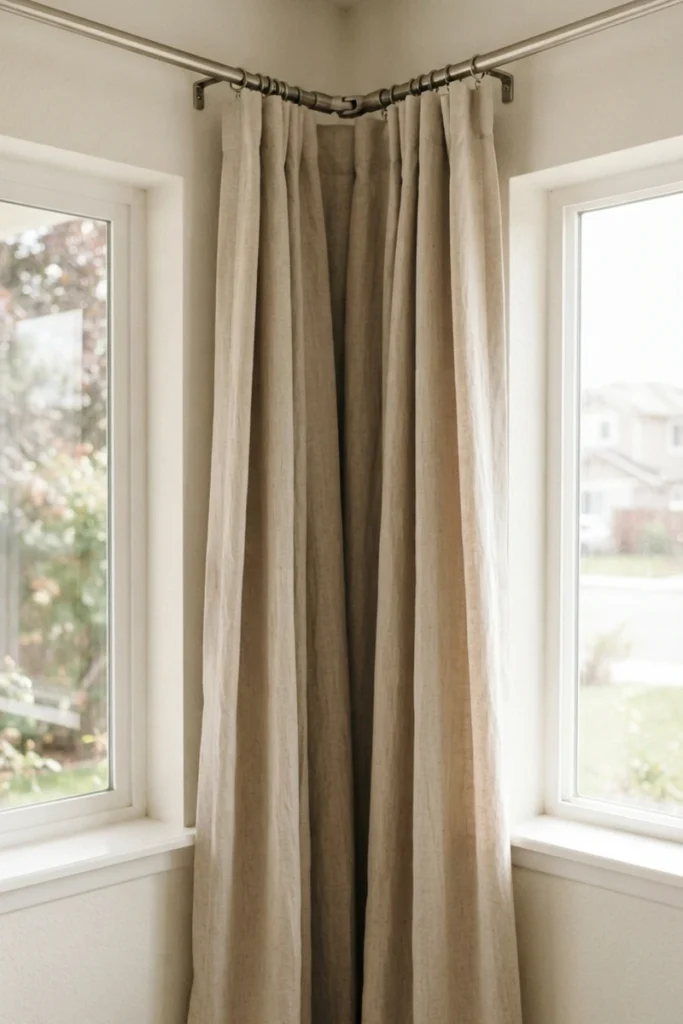
Purpose-built corner curtain rods use a hinged or adjustable joint that lets the rod bend to match the exact angle where the two windows meet, allowing one continuous curtain to wrap around the corner. This creates the most seamless look of any corner window solution, since there’s no visible gap or break at the point where the windows meet. The trade-off is that these specialty rods cost more than standard hardware and can be harder to find in stores, often requiring an online order. Home improvement guides generally recommend having corner or specialty hardware professionally measured before ordering, since even a small angle mismatch can prevent the rod from closing smoothly.
Best for: Corner windows that meet with little or no wall space between them, where a seamless wraparound look matters.
Two Separate Curtains Treated Independently
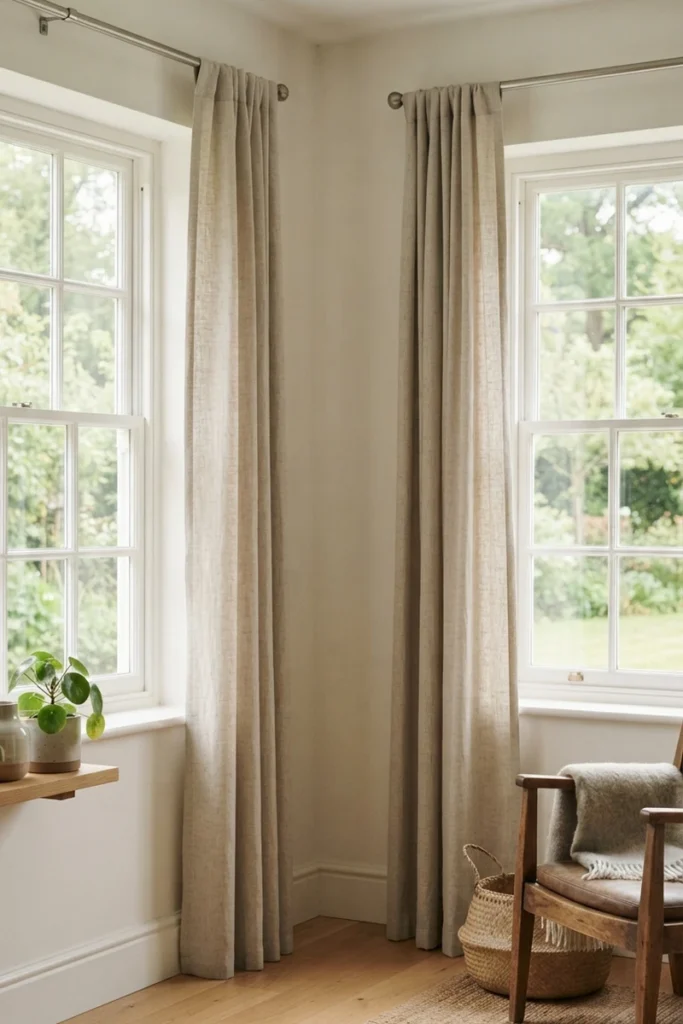
Rather than trying to bridge the corner, this approach simply treats each window as its own separate unit, with its own standard rod and curtain that starts and stops at the edge of each window. It’s the most affordable and widely available option, since it uses completely standard hardware with no specialty parts required. The visible gap at the corner is more noticeable than a continuous wrap, though many people find it reads as intentional rather than awkward, especially with matching fabric on both sides.
Best for: Corner windows with some wall space between them, or anyone prioritizing budget and simplicity over a seamless look.
A Single Wide Panel Covering Both Windows
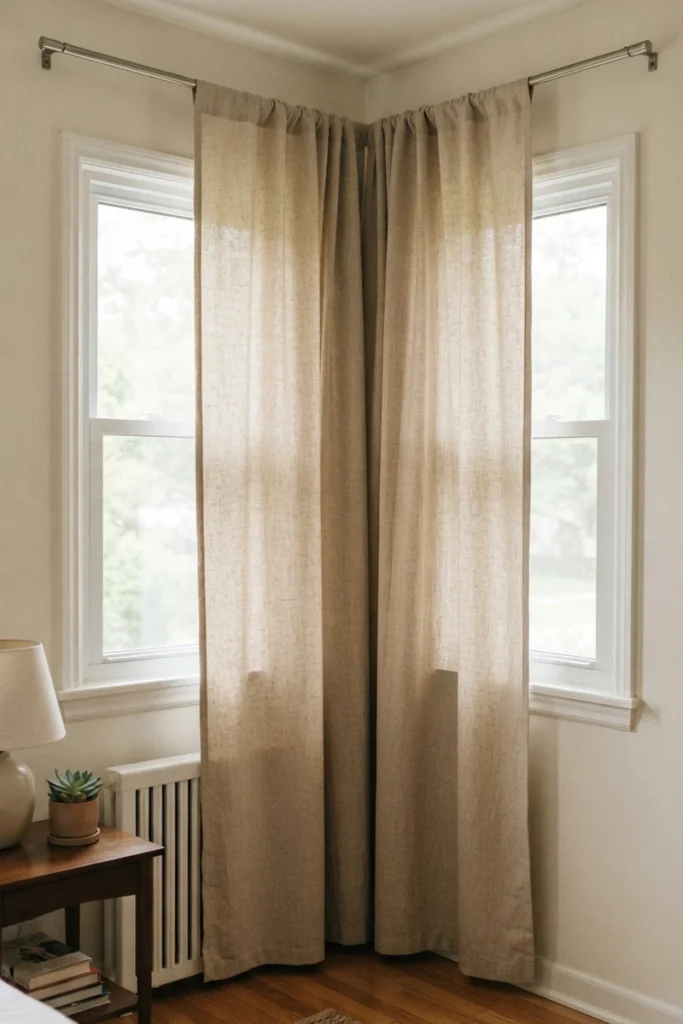
For corners where the windows are close enough together, one extra-wide curtain panel — mounted on a straight rod positioned to cover both windows from an angle — can visually bridge the gap without any specialty hardware. This works best when the curtain is left mostly stationary rather than opened and closed daily, since the flat panel doesn’t actually follow the corner’s angle. It’s a simple, lower-cost way to create the impression of a unified treatment without hinged hardware.
Best for: Corner windows that are mostly decorative or rarely opened, where a specialty rod isn’t worth the investment.
Corner Window Solutions Comparison at a Glance
| Feature | Corner-Specific Rods | Two Separate Curtains | Single Wide Panel |
|---|---|---|---|
| Seamlessness | Highest | Lowest (visible gap) | Moderate |
| Cost | Higher | Lower | Lower |
| Independent operation | Limited | Yes | No |
| Best for | Tight corner windows | Windows with wall space between | Mostly decorative corners |
How to Choose the Right Corner Window Approach
Start with how much space actually separates the two windows — windows meeting directly at the corner benefit most from purpose-built hinged hardware, while windows with wall space between them can be treated as two independent units without much visual downside. From there, think about how often you’ll actually open and close the curtains: frequent daily use points toward either corner-specific rods or two separate curtains, both of which allow real operation, while a mostly-decorative corner can get away with a simpler stationary panel.
FAQ
Are corner curtain rods hard to install myself?
They’re more involved than a standard straight rod since the hinge needs to align precisely with the corner angle, but most come with clear instructions and don’t require professional installation for most homeowners.
Can I use the same curtain fabric on both sides of a corner window?
Yes, and it’s generally recommended — matching fabric on both windows keeps the corner treatment feeling unified, whether you’re using specialty hardware or two separate curtains.
What if my corner windows are different sizes?
Two separate curtains treated independently handle mismatched window sizes most easily, since each side can use its own appropriately-sized panel rather than trying to force one continuous piece to fit two different widths.
Final Thoughts on Corner Window Curtains
Whichever hardware approach you choose, getting the fullness right on each panel still matters for how finished the final look feels. Our curtain fullness guide breaks down how much extra fabric width different fabrics need.